#liberal #anticapitalism

An #EconomicDemocracy is a market economy where most firms are structured as #WorkerCoops.

#liberalism
#coops #cooperatives

  • 14 Posts
  • 187 Comments
Joined 2 年前
cake
Cake day: 2023年7月18日

help-circle


  • 4/5

    It is irrelevant that some workers don’t want to be held responsible for the positive and negative results of their actions (the whole result of production). Responsibility can’t be transferred even with consent. If an employer-employee cooperate to commit a crime, both are responsible. This argument is establishes an inalienable right i.e. a right that can’t be given up or transferred even with consent like political voting rights today


  • 3/5
    The idea that the employer is production’s whole result’s just appropriator due to the risk they bear is tautological and circular reasoning. Risk, in this case, refers to bearing the liabilities for used-up inputs, which is production’s whole result’s negative component. It ignores the joint de facto responsibility of workers in the firm for using up inputs to produce. By the norm of legal and de facto responsibility matching, workers should get the whole result of production


  • 1/5

    Worker coops can have managers. Managers’ interests can be aligned with the long term interests of the firm by giving them non-voting preferred shares as part of their compensation. Managers will make sure workers they are managing perform. The difference is that these managers are ultimately accountable to the entire body of workers and are thus their delegates.

    Profits/wages don’t have to be divided equally among workers.

    I’m going to use multiple toots since I’m on Mastodon


  • Your reforms sound good, but aren’t pragmatic. Today’s system requires you to have lobbyists to push an agenda through. Who is going to fund the lobbyists to make these reforms happen.

    Also, even in an ideal capitalism, there is still an injustice at the heart of the system. The employer-employee contract violates the tenet of legal and de facto responsibility matching. The workers are jointly de facto responsible for production, but employer is held solely legally responsible.

    @technology


  • I am a mutualist as well. I just use the term, economic democracy as David Ellerman calls it, instead because mutualism doesn’t seem as clear. Also, mutualism has anarchist connotations, which I am sympathetic to, but I believe the movement to abolish capitalism should be broader than anarchism.

    In other words,

    anarchist economic democracy = mutualism

    @196


  • J Lou@mastodon.socialto196@lemmy.blahaj.zoneAnarchist Rule
    link
    fedilink
    arrow-up
    1
    arrow-down
    1
    ·
    1 年前

    I am an anti-capitalist.

    To get rid of capitalism, you don’t have to abolish absentee ownership of capital. A worker coop can lease capital from third parties and remain a non-capitalist democratic worker coop. Abolishing capitalism just requires abolishing the employment contract and common ownership of land and natural resources. Without the employment contract, everyone is either individually or jointly self-employed, so every firm is a worker coop

    @196


  • J Lou@mastodon.socialtoScience Memes@mander.xyzEat lead
    link
    fedilink
    arrow-up
    0
    arrow-down
    1
    ·
    1 年前

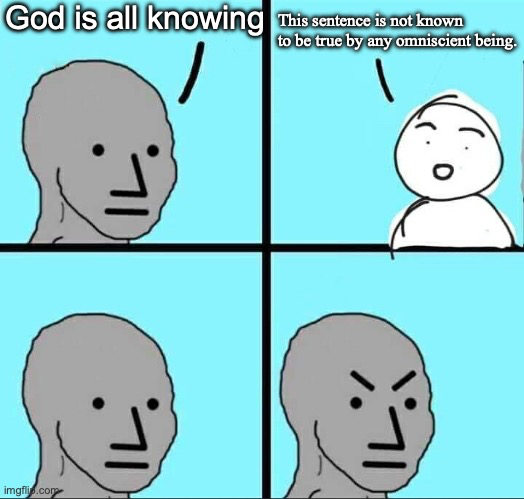
    It is a paradox if you believe there are omniscient beings. If there are no omniscient beings, there is no paradox. The sentence is either true or false. If the sentence is true, we have an omniscient being that lacks knowledge about a true statement. Contradiction. If it is false, there is an omniscient being that knows it to be true. This means that the statement is true, but the statement itself says that no omniscient being knows it to be true. Contradiction.

    @science_memes


  • Self-referential paradoxes are at the heart of limitative results in mathematical logic on what is provable, so it seems plausible a similar self-referential statement rules out omniscience.

    Greek gods are gods in a different sense than the monotheistic conception of god that is omniscient, omnipotent and omnibenevolent. Sure, so the argument I give only applies to the latter sense.

    @science_memes